


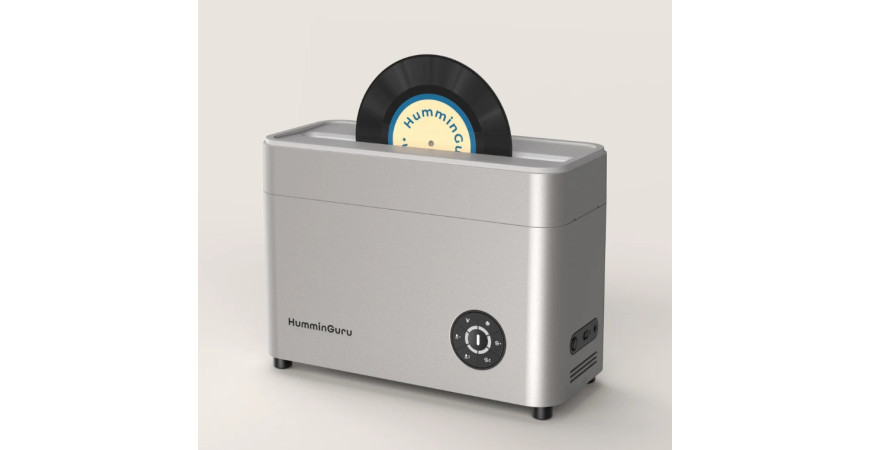
A clean record sounds quieter and wears the stylus less. An ultrasonic machine reaches the bottom of the groove without touching it: no brushes on the surface, just distilled water set into vibration.
In this guide we explain how it works, which settings really matter and how to use it without risk to your records. We rely on verifiable sources: the precision cleaning manual by Neil Antin, formerly the US Navy's technical lead for precision cleaning processes, the guidance of the Library of Congress and the manufacturers' manuals.
A transducer makes the water vibrate at ultrasonic frequency. The vibration creates microbubbles that grow and then implode: this is cavitation. Each implosion produces a jet and a pressure wave that lift dirt off the groove walls, with no mechanical contact at all.
The frequency sets the size of the bubbles. According to Antin, a bubble measures about 75 µm at 40 kHz and about 20 µm at 120 kHz. Large bubbles are more energetic; small bubbles are more numerous and more evenly spread.
| Frequency | Bubble (approx.) | Strength | Examples |
|---|---|---|---|
| 40 kHz | 75 µm | Energetic action, larger particles | HumminGuru HG01, HumminGuru NOVA |
| 120 kHz | 20 µm | Fine, even action, smaller particles | Degritter Mark II |
There is no single right frequency. Power per litre of water, temperature and surfactant matter too. The surfactant lowers surface tension: the water wets the groove better and cavitation needs less energy.
The two systems are not rivals: they solve different problems.
A very dirty used record should first be cleared of debris with a brush or a microfibre cloth. Only then should it go into the ultrasonic machine. People who buy a lot of used records often use both systems: vacuum as a pre-wash, ultrasonic as the finish. Some machines combine the two, such as the Knosti Disco Antistat Ultrasonic, with ultrasound and goat-hair brushes.
Water. Distilled or demineralised water only. Tap water leaves limescale in the groove and in the machine. For fresh water, Antin recommends less than 2.5 ppm of dissolved solids.
Surfactant. A few drops of a low-foam non-ionic surfactant designed for ultrasonic use are enough. Sound archives such as the Library of Congress use solutions of this kind based on Tergitol. In compact machines foam upsets the pump, so keep doses low. More detergent does not mean cleaner: in Antin's tests an excessive dose left an audible film on the record. For HumminGuru machines the manufacturer specifies 2-3 drops of its own fluid; unauthorised products void the warranty.
Alcohol. Not needed. Antin advises not to exceed 2.5% in an ultrasonic machine, partly because isopropyl alcohol becomes flammable at around 10%. On shellac 78s alcohol is forbidden: it dissolves them.
Temperature. This is the real risk. HumminGuru recommends water between 25 and 35 °C at the start of the cycle. Antin considers about 35 °C optimal and points out two thresholds:
Ultrasound heats the water as it works. That is why the HG01 should not be run for more than an hour at a time and then needs to cool for at least 30 minutes. HumminGuru machines also have thermal protection that stops them at around 55 °C.
Labels and delicate records. Respect the water level for each format so the label stays dry. If it gets wet, stop the cycle and dry it. HumminGuru machines are rated for PVC records only. The British Library, which uses an ultrasonic bath, also avoids it on cracked or damaged records.
The example is a HumminGuru, but the principles apply to any machine.
Looking after the machine
Does ultrasound damage the groove? With a machine designed for records and the temperature under control, technical sources report no damage. The real risk is heat, not frequency.
Will a scratched record be like new? No. The scratch stays. The crackle caused by dirt does go away, though, and it is often most of it.
Should new records be cleaned too? Yes. They can carry pressing residues and dust from the paper sleeve.
What about 78s? HumminGuru machines are rated for PVC only. Shellac needs a dedicated procedure, always without alcohol.
The mistakes we see most often:
Ultrasonic machines
Fluids, spares and accessories


























Please sign in first.
Sign in
Create a free account to use wishlists.
Sign inChoose which categories to enable. Necessary cookies are always active. You can change your choices at any time from “Cookie preferences” at the bottom of every page.
They make the site and the services you request work: cart, account login, language, site search (Motive), payments (PayPal, seQura, Scalapay), spam protection for forms (Cloudflare Turnstile) and remembering your cookie choices. Cookies: PrestaShop-… (20 days), PHPSESSID (until you close the browser), psc (6 months).
They show content from other services on our pages: Disqus comments and YouTube and Vimeo videos. These services may use their own cookies and collect data about your browsing. Until you enable them, you will see a box in their place from which you can do so.
They help us understand, in aggregate form, how the site is used and how quickly pages load. Services: Google Analytics (_ga and _ga_* cookies, 2 years) and New Relic.
They measure the effectiveness of our campaigns, show you relevant ads and personalise our emails based on your browsing. Services: Google Ads (_gcl_* cookies, 90 days) and Klaviyo (__kla_id cookie, 2 years).


 Italiano
 Deutsch
 Français
 Español