


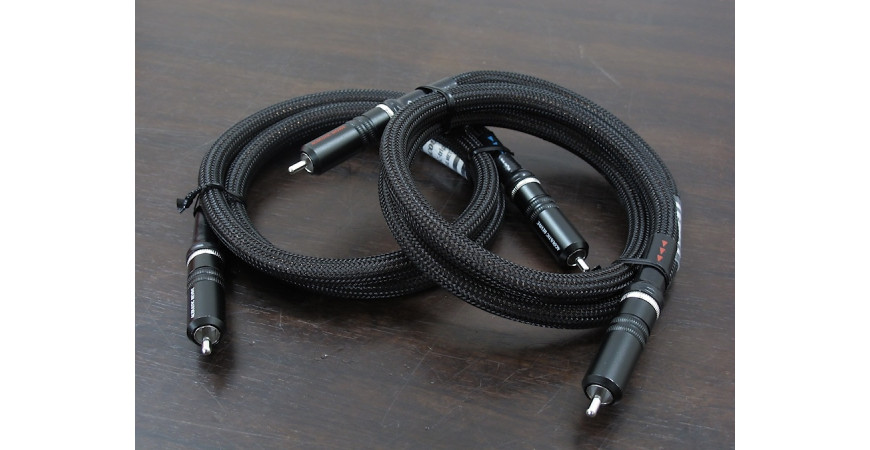
In 2013 the best-loved conductor in Japanese hi-fi went out of production. Acoustic Revive replaced it with PC-Triple C, a copper made by forging, and paired it with FINEMET rings against electromagnetic noise. Within months the new cable series had won over the Japanese specialist press. Here is the story, how it works and what the reviewers wrote.
For many years the reference for Japanese audio cables was Furukawa Electric's PC-OCC: a very high-purity copper made with the continuous casting process invented by Professor Atsumi Ohno, which produces extremely long crystals. On 4 March 2013 Furukawa announced that it would stop making it.
Acoustic Revive used it in its PCOCC-A series. It therefore announced that, from May 2014, those cables would be gradually replaced by a new series with PC-Triple C conductors, unveiled at High End Munich the same year.
PC-Triple C stands for Pure Copper – Continuous Crystal Construction. It was developed in Japan by FCM, a company of the Furukawa group. The starting point is high-purity oxygen-free copper, which is then forged: the wire is compressed over and over, from precise angles and directions. The crystals are packed together and lined up continuously along the wire, which is the direction the signal travels.
Unlike PC-OCC, it is not a "single-crystal" copper. According to the manufacturers its advantage lies elsewhere: the boundaries between crystals are almost free of impurities, and the process is less prone to the production flaws that could affect PC-OCC. Acoustic Revive describes it as a conductor that can only be made through a traditional Japanese forging process, the same idea behind katana blades.
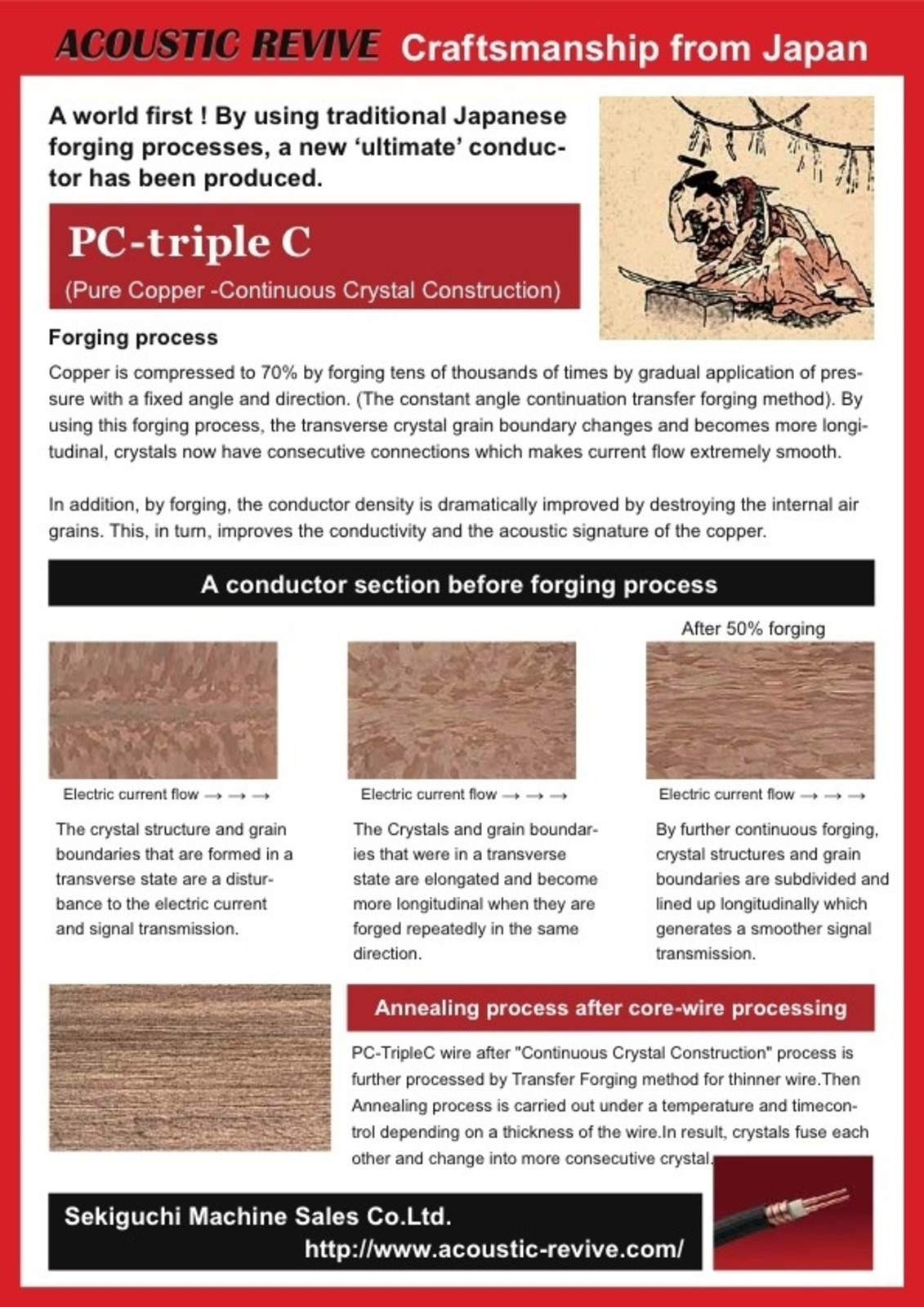
The panel Acoustic Revive used to introduce PC-Triple C at High End Munich 2014.
The second new feature is the FINEMET rings. FINEMET is a nanocrystalline magnetic material developed by Hitachi Metals (now Proterial) and used in electronics for filters against electromagnetic interference. Fitted on the cable, the ring acts as a filter for the high-frequency noise travelling along it.
In the Acoustic Revive cables marked FM, such as the RCA-1.0 TripleC-FM and the XLR-1.0 TripleC-FM, the PC-Triple C conductor and the FINEMET rings work together. According to Acoustic Revive, the result is a much higher signal-to-noise ratio without taking anything away from the original signal.
At its debut at High End Munich 2014 (room C-08, Hall 2), the Acoustic Revive room was named the best of the show by the Polish magazine High Fidelity, and many visitors said the same.
Shortly afterwards Ken Ishiguro, Acoustic Revive's designer, gave a demonstration at a well-known hi-fi shop in Osaka. The system was top of the range: an Esoteric CD player and electronics, connected with some of the most expensive and famous cables in the world. Ishiguro replaced only the interconnect between the player and the preamplifier with the new PC-Triple C. According to Acoustic Revive's account, everyone in the room immediately noticed a lower noise floor, a stronger three-dimensional effect and a wider, deeper and more solid soundstage. When the original cable went back in, everyone heard the sound get worse.
In 2015 the Japanese book Cable Taizen 2015 (ケーブル大全, literally "cable encyclopedia") asked 14 specialist journalists to name their three best cables of the year. All 14 included an Acoustic Revive PC-Triple C cable in their top three. Here is a selection of their comments.
"The XLR-1.0 TripleC-FM is an unrivalled interconnect. Its accuracy, the amount of information and the sense of power across the whole range are exceptional, yet the sound has no excess: it is as if there were no cable at all." Journalist B
"Extraordinary imaging and resolution. With the PC-Triple C conductor the sound is so much better that it feels as if the whole system had been changed." Journalist C
"I feel bound to recommend a product that is truly worth its price, and this time I have no doubts: the RCA-1.0 TripleC-FM. In my own system the difference was clearly audible. It will remain a reference for a long time." Journalist H
"In my recording and mastering work an interconnect has to do three things: pass the signal directly, with no added colouration; be perfectly shielded from electromagnetic fields; and render space superbly, with an accurate soundstage and the harmonics of voices and instruments. Only the XLR-1.0 TripleC-FM does all three." Journalist J
"Performance I had never heard before, not even with cables costing 3,000 to 5,000 dollars." Journalist L
"PC-Triple C together with the FINEMET rings gives a lively sound. It is rare to get such a clear improvement just by changing an interconnect." Journalist N
These are enthusiastic words, and they should be read for what they are: listening impressions from people who tried these cables in their own systems.
Since then PC-Triple C has become one of the most widely used conductors in Japanese hi-fi, used among others by SAEC and Furutech. Acoustic Revive built a whole range on it, from interconnects to speaker, power and digital cables. For its flagship Absolute series it later introduced PC-Triple C/EX, a hybrid conductor in which silver and copper are joined by forging.
Reviews help you decide what to listen to. The decision, though, should come from listening: with your music, in your system. The right cable is the one that makes you forget the system and brings you back to the music.
On PlayStereo you will find, among others:
The whole range is on the Acoustic Revive brand page. For advice on your system, get in touch.
Version with Acoustic Revive Power Reference Oyaide cryo Schuko plug and Furutech IEC plug (see image 2).

























Bitte melden Sie sich zuerst an.
Anmelden
Erstellen Sie ein kostenloses Konto, um Wunschlisten zu nutzen.
AnmeldenWählen Sie, welche Kategorien Sie aktivieren möchten. Notwendige Cookies sind immer aktiv. Sie können Ihre Auswahl jederzeit über „Cookie-Einstellungen“ unten auf jeder Seite ändern.
Sie sorgen dafür, dass die Website und die von Ihnen angeforderten Dienste funktionieren: Warenkorb, Anmeldung im Kundenkonto, Sprache, Suche auf der Website (Motive), Zahlungen (PayPal, seQura, Scalapay), Spamschutz für Formulare (Cloudflare Turnstile) und Speicherung Ihrer Cookie-Auswahl. Cookies: PrestaShop-… (20 Tage), PHPSESSID (bis zum Schließen des Browsers), psc (6 Monate).
Sie zeigen auf unseren Seiten Inhalte anderer Dienste an: Kommentare von Disqus sowie Videos von YouTube und Vimeo. Diese Dienste können eigene Cookies verwenden und Daten über Ihr Surfverhalten erheben. Solange Sie sie nicht aktivieren, sehen Sie an ihrer Stelle einen Hinweis, über den Sie sie aktivieren können.
Sie helfen uns zu verstehen, wie die Website genutzt wird und wie schnell die Seiten laden – in zusammengefasster Form. Dienste: Google Analytics (Cookies _ga und _ga_*, 2 Jahre) und New Relic.
Sie dienen dazu, den Erfolg unserer Kampagnen zu messen, Ihnen relevante Werbung zu zeigen und unsere E-Mails auf Ihr Surfverhalten abzustimmen. Dienste: Google Ads (Cookies _gcl_*, 90 Tage) und Klaviyo (Cookie __kla_id, 2 Jahre).


 Italiano
 English
 Français
 Español